Tue Mar 17, 2026 | Updated 09:00 PM IST

-1773226627825.png)
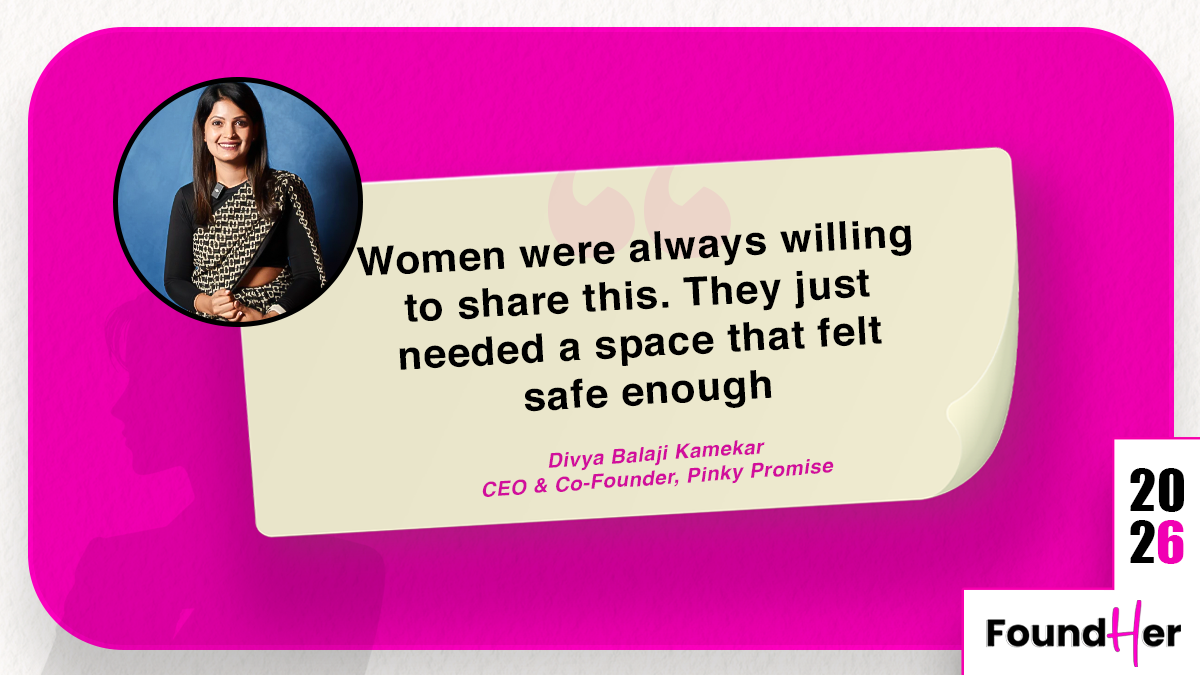
"Women Are More Honest With an AI Than With Their Own Doctor. That Says Everything", Divya Balaji Kamekar, CEO and Co-Founder of Pinky Promise, sat down with HerZindagi to talk about shame, silence, and why she built the digital clinic where 350,000 Indian women finally felt safe enough to walk into.
Divya Balaji Kamekar noticed this pattern. Instead of ignoring it, she decided to build something around it.
That idea became Pinky Promise, India’s first AI-enabled digital clinic focused on women’s health. The platform was inspired by her own difficult pregnancy during the pandemic and by years of working in healthcare across different regions. Today, Pinky Promise has helped more than 350,000 women across every district in India, offering consultations with qualified gynaecologists starting at ₹99. The service is available 24 hours a day in Hinglish and English.
This is part of our 'FounderHer' series, where we spotlight inspiring women entrepreneurs and their unique journeys. If you are a woman founder, apply for our flagship 'Womenpreneur Awards' 2026 and 'Nomination Form Here'.
Divya was studying for her MBA at the Wharton School when the COVID-19 pandemic began. She returned to India for the birth of her first child. Soon after, she realised something was wrong.
"For two weeks, I went from one doctor to another before I finally got a diagnosis," she says. "What stayed with me was that the problem could have been identified much earlier if the doctor had received the right information about my symptoms from the start."
The medical knowledge already existed. The problem was that the information never reached the doctor in time.
That gap, between what medicine knows and what reaches a woman in time, had been something Divya had watched play out across geographies for years. She had worked in Tanzania on HIV access for women, in Bihar on malnutrition, and at the Delhi Commission for Women in the aftermath of the Nirbhaya case. Her own pregnancy gave it a name she could no longer ignore.

Before a single line of product code was written, Divya polled over 300 women across India about what they actually do when they face a gynaecological problem. The results were unsurprising.
More than 70% said they avoid visiting a gynaecologist even when they know they should. Around 73% said their first step is searching online, because it feels more private than speaking to someone in person.
-1773227208214.png)
The numbers behind the system tell the same story. India has roughly 70,000 gynaecologists for approximately 670 million women. Most of these doctors work in big cities. For many women in smaller towns, seeing a doctor can mean travelling long distances, missing work, arranging childcare, and spending money the family may not have.
"Then there is the social layer, which in many ways is even harder to shift than the supply gaps," Divya says. "A woman may know for weeks that something is wrong. But she cannot ask her mother-in-law for money to see a doctor without explaining why. She cannot have that conversation with her husband. So she waits. And in reproductive health, waiting routinely turns a manageable problem into a more serious one."
When Pinky Promise first started, the team tested early versions of the service using simple tools like spreadsheets and a WhatsApp chatbot. Very quickly, they noticed something interesting.
-1773227280986.png)
"Women are more honest about their symptoms to a completely faceless system than to even the most approachable human being," Divya says simply. "That told us what kind of product we needed to build."
The questions women ask are often simple: delayed periods, PCOS, unusual discharge, or emergency contraception. These are common health concerns. Yet many women feel too embarrassed to discuss them openly.
Divya believes the problem comes from the way sexual health is treated in India, "We rarely talk about these issues openly," she says. "So women end up carrying a lot of unnecessary shame."
Every month, millions of searches related to women’s health are made online in India. The need for information has always existed; the healthcare system simply did not offer an easy way to ask those questions.
When we ask Divya for a user story that shook her, she does not pause, "One patient came to us with period pain she had been managing, or rather failing to manage, for ten years. She had been hospitalised for it. And she came to us with one request: make this stop."
After reviewing her symptoms carefully, the Pinky Promise doctors realised she had endometriosis, a condition that had never been properly diagnosed before.
Three months later, the woman sent her a photo of a positive pregnancy test. Recently, she gave birth to twins.
"Moments like that remind us why we built this platform," Divya says. "It allows women to receive care in a way that feels comfortable for them."
One gynaecologist in a clinic sees 30 to 40 patients a day. Pinky Promise's AI, trained on over 10,000+ gynaecological sources, is designed to change that equation entirely.
"What we use AI to do is to 100x that good gynaecologist's capacity," Divya explains. The AI handles file-making, history-taking, basic triage, and draft prescriptions, freeing doctors to do the one thing that actually requires them: think, diagnose, explain, and care.
And the guardrail is non-negotiable. "Not a single line of medical information leaves our app without a doctor approving it," she says. Coming from a family of doctors herself, Divya is clear-eyed about what technology can and cannot replace. "Nothing can replace that human touch. But AI, if built ethically and democratically, has immense potential to make our doctors serve our country's women more effectively."
"You do not need permission from a credential or an institution to have a legitimate point of view on the thing you have lived."
We ask the question she has been asked many times, differently. Not how she balances it all, but what she has had to give up.
"Honestly? Nothing," she says. "I start my days very early, when the children are sleeping, by going to the gym. Then I am with them before they head to school, and I make it a rule to come home before they sleep. If I am not able to do all of this, I believe I will not thrive at work or be an effective, happy and motivated leader."
But she is quick to add the part that often gets left out of these conversations. "I am unable to do any of this without a huge army of support, my husband, my parents, my in-laws, and nannies. All of them support everything I do with a genuine desire to see me grow." Then she adds, "Even the nannies of my children are fans of Pinky Promise. We all work together as a team."
Divya is the daughter of a civil servant. She studied at Yale on a scholarship, earned an MBA at Wharton, was named to the Director's List, worked in Tanzania, Bihar, and Delhi before building one of India's most important health platforms. She has credentials most founders only dream of.
And yet, the one thing she wishes someone had told her earlier is the one thing she now says to every young woman who asks, "Being close to a problem gives you valuable insight," she says. "Never let anyone tell you that your experience does not matter."
A girl from a small town who wants to build something for women like her already has the most valuable thing: she knows what it feels like not to have a gynaecologist within reach, not to be able to have a health conversation at home, to search something up in the middle of the night because there is no other safe moment.
"The insight that drives the best ideas almost always comes from having been closest to the problem," Divya says. "That part is already hers."
Keep reading Herzindagi for more such stories.
Image Courtesy: Instagram
Our aim is to provide accurate, safe and expert verified information through our articles and social media handles. The remedies, advice and tips mentioned here are for general information only. Please consult your expert before trying any kind of health, beauty, life hacks or astrology related tips. For any feedback or complaint, contact us at [email protected].