Tue Mar 17, 2026 | Updated 07:26 PM IST


The world of finance has long been viewed as a "man's world”, a world where a man will tell you how to take care of your finances. While this had been the archaic thinking that many still believe in today, breaking the gender stereotypes today is the CEO of Paisabazaar, Santosh Agarwal. For decades, a ‘confidence gap’ has led our society to instinctively turn to men for financial direction, leaving women sidelined in their own economic journeys. Santosh’s rise in this male-dominated fintech sector is proof of how the industry is changing for the better and letting everyone get a seat at the table, and not just men. Her journey is an inspiration for many women and makes people want to get more educated about finances.
Santosh Agarwal shares her journey of navigating a male-dominated industry and the importance of early financial literacy here. Find out why the boldest career move you can make is simply to start before you feel ready.
This is part of our FounderHer series, where we spotlight inspiring women entrepreneurs and their unique journeys. If you are a woman founder, apply for our flagship Womenpreneur Awards 2026 and Nomination Form Here.
Santosh’s journey in the world of finance began when she was just a child. She shared memories from her childhood that inspired her to build a career in the fintech industry. “Growing up in a business family, I spent much of my early years assisting my father alongside my education. That exposure gave me a natural inclination toward sales, problem-solving, and understanding consumer behaviour. I realised quickly that I enjoyed building businesses.”

When Santosh joined Policybazaar, the opportunity to solve real access and awareness gaps at scale really excited her. She talked about the industry, stating, “Fintech, at its core, is about democratising access. The chance to build solutions that empower millions of consumers, that is what continues to inspire me.” Stepping into the role of CEO at Paisabazaar was never part of her predefined plan. Consistency, hard work, and perseverance opened more doors than any prestigious institution ever could for Santosh.
With your role, added responsibilities, and new challenges tend to occupy your schedule. Santosh Agarwal recalls one of the biggest challenges about her role was working in a category that consumers didn’t fully understand or pay enough attention to. “When I began my journey in insurance, awareness levels were low. Insurance was largely sold, not bought. It was seen as a tax-saving tool rather than a protection need.” She talked about how building in such an environment, their challenge wasn’t just distribution, it was about education. Santosh talked about this, saying, “We had to simplify complex products, build trust in digital comparison, and help consumers make informed choices instead of relying purely on agents.”
She further stated how these challenges from her early days later became a part of how they approached customers. “In the early days, convincing consumers to buy financial products online wasn’t easy. But those challenges also shaped our approach — transparency, comparison, and education became core principles. Looking back, the difficulty of building in a low-awareness market is what made the journey meaningful.”

Santosh has always believed that the fundamentals of leadership are gender-neutral. In her early days, she focused on four principles that shaped her journey. Her first principle was to be a student. “First, be a student at all times. In financial services, credibility comes from understanding the product deeply. I invested time in learning from customers, from colleagues, and from the market.”
Her second principle was about ownership. “Second, take ownership, even when things are uncertain. Visibility and growth come when you raise your hand for responsibility, not when you wait for perfect conditions.”

In this fast-paced world, Santosh’s third principle will help you create long-term connections with people. “Third, build relationships, not just networks. Trust compounds over time, and strong professional relationships become your biggest enablers during tough phases.”
Santosh’s fourth principle is about putting in the effort, even in times of self-doubt. “Confidence doesn’t come from perfection, it comes from action and execution. There were moments of doubt, of course. But progress happens when you move forward despite them.”
She is a firm believer that your performance speaks louder than perception. Santosh thinks that when you consistently deliver outcomes, credibility follows, regardless of your gender.
While today's women are becoming more independent and financially literate, there is still a huge number of women who only dream about achieving these things. Santosh says, “The biggest barrier is not capability, it is confidence and early conditioning. In many households, women actively manage day-to-day finances but are not always part of larger financial decision-making. Over time, this creates a gap in exposure and confidence, even when the ability is clearly there.” 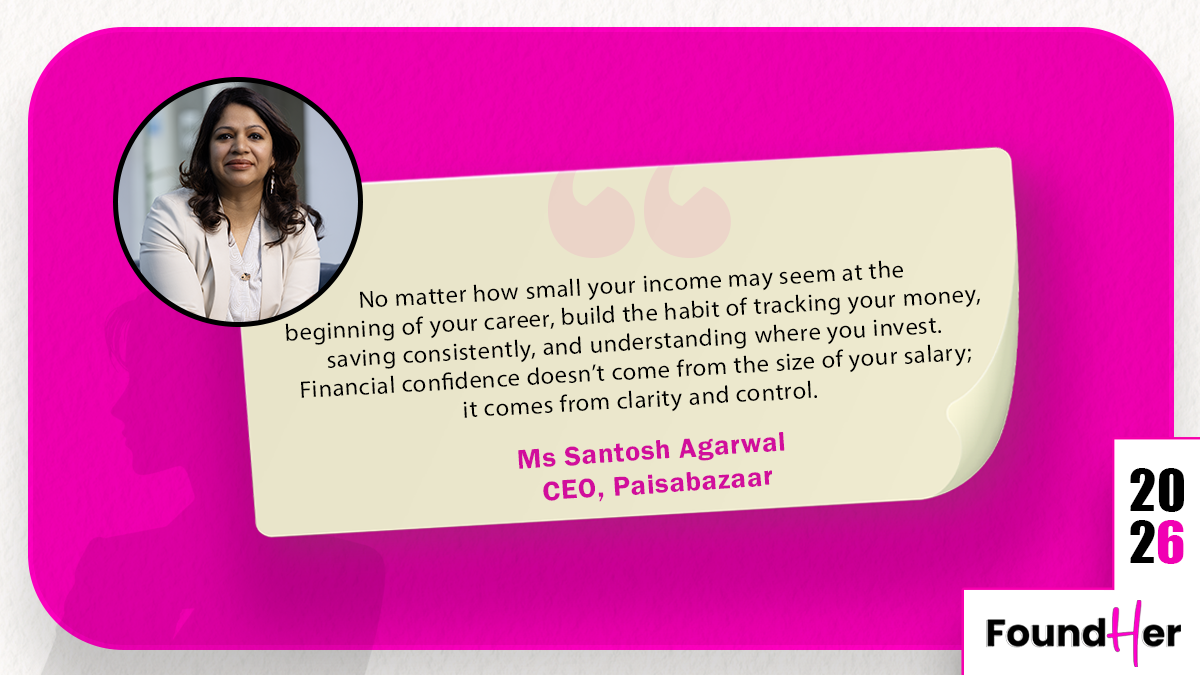
She also pointed out how financial literacy isn’t treated like an essential life skill in our education system, despite its daily importance. As a result, many women begin engaging with formal financial products much later in life, often after marriage or a major life event, rather than building familiarity early on.
Following the principles Santosh practices, start taking ownership of your finances as early as you can. “No matter how small your income may seem at the beginning of your career, build the habit of tracking your money, saving consistently, and understanding where you invest. Financial confidence doesn’t come from the size of your salary; it comes from clarity and control.”
Santosh also suggests the solution to bridge this gap as, “To truly move the needle, financial education must start early and become gender-neutral. Access has improved dramatically through digital platforms, but awareness, confidence, and inclusion in decision-making conversations need equal attention.”
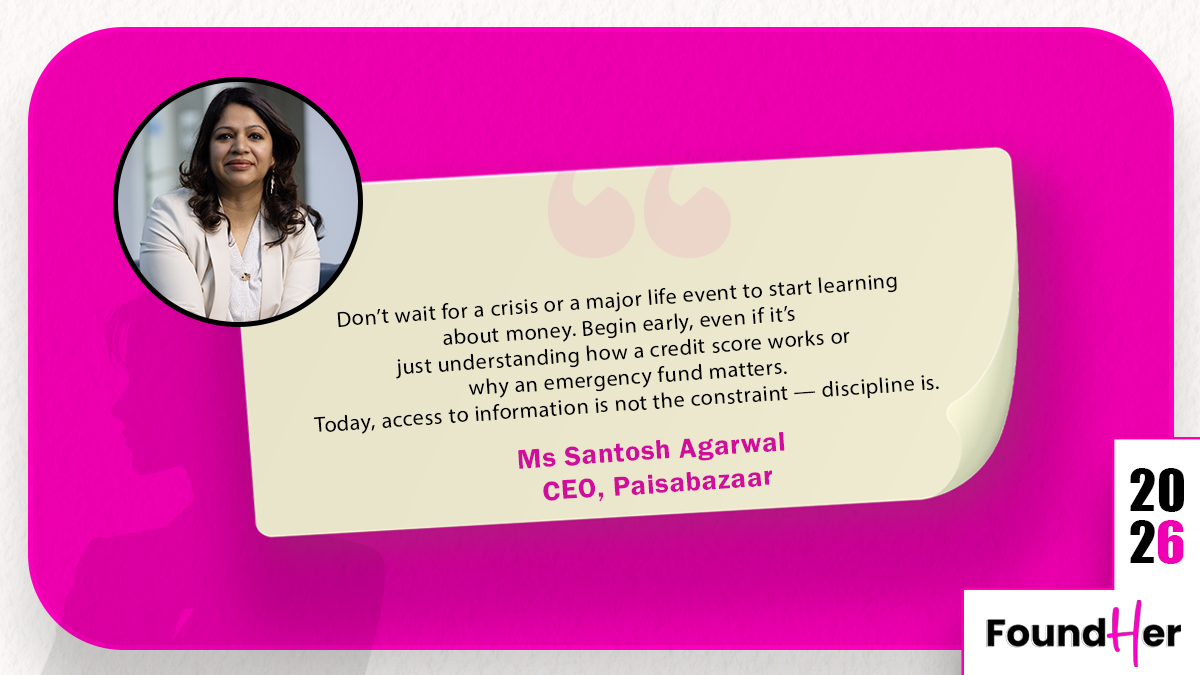
She insists that people understand that personal finance is a non-negotiable life-skill that you need to have to lead a quality life. She says, “Don’t wait for a crisis or a major life event to start learning about money. Begin early, even if it’s just understanding how a credit score works or why an emergency fund matters. Today, access to information is not the constraint, discipline is.”
Santosh suggests that you should track your own financial data and build a strong financial portfolio. Other tips that you can follow are to build an emergency fund, get adequate life and health insurance, check your credit score regularly, and invest for the future. You need to understand how EMIs impact your long-term cash flow. Start reviewing your investments periodically. When you see your own numbers, financial decisions become real, not abstract.
To all the women trying to get independent and financially literate, Santosh Agarwal has one message for you, “Have faith in your own capability”.
For more such stories, stay tuned to HerZindagi.
Also watch this video
Herzindagi video
Our aim is to provide accurate, safe and expert verified information through our articles and social media handles. The remedies, advice and tips mentioned here are for general information only. Please consult your expert before trying any kind of health, beauty, life hacks or astrology related tips. For any feedback or complaint, contact us at [email protected].